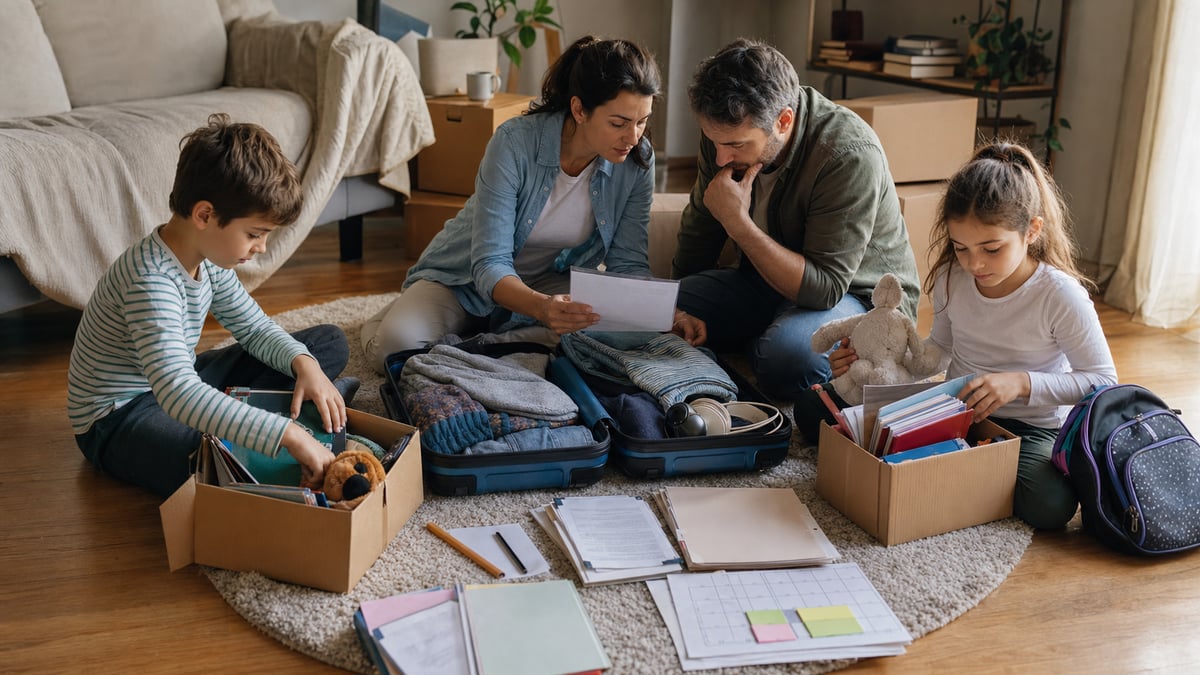
Published by Jimmy 7 minutes read Family & Education
Moving Abroad With Kids: Timing, Paperwork and the Settling In
Children add a layer to every part of a move - school year timing, enrolment paperwork that must be certified before you leave, childcare waiting lists, and an adjustment curve that runs on its own schedule. Here is what to plan for.
Moving with children is not the same move with extra luggage. It changes the timing, the paperwork, the housing decision, and the emotional arc of the whole first year — including yours, because you will be settling them before you settle yourself.
None of this is a reason not to go. Children who grow up across two cultures generally end up with something valuable. But the version of the move that works for a family is planned differently, and here is where the differences actually bite.
Timing around the school year
This is the constraint that should shape your calendar, and it is the one most easily got wrong because school years do not begin in the same month everywhere. Southern hemisphere countries run on a different cycle entirely, and even within Europe start dates vary by weeks.
The ideal is to arrive a few weeks before term begins. That gives you time for enrolment paperwork, uniform and equipment, and a bit of settling before the child walks into a new school — and, importantly, it means they start when everyone else does rather than joining an established class as the new foreign kid in November.
If you cannot manage that, mid-year moves are survivable and schools do this all the time. But if you have any flexibility, use it here rather than anywhere else.
Note that this may collide with your own timeline: job start dates, permit issue dates and lease availability rarely arrange themselves around a school calendar. Where they conflict, it is often worth one parent arriving first to set things up while the children finish a term.
The paperwork, which starts before you leave
Enrolment typically requires a birth certificate, proof of address, immunisation records, previous school reports or transcripts, and identification for child and parent. For older children moving mid-education, expect requests for detailed transcripts and sometimes a formal assessment of level.
Almost all of these need translation, and many need certification — an apostille or consular legalisation — and that must happen in the country that issued them. Obtaining a certified copy of a school transcript from a school in another country, at a distance, is a genuinely miserable errand. Do it before you leave, along with everything else in the pre-departure document sweep described in your first 90 days abroad.
Immunisation records deserve particular attention. Schedules differ between countries, and children may need catch-up vaccinations to meet local requirements — which in some countries are a condition of school attendance. Get a full record from your doctor, listed by vaccine rather than by local brand or schedule name, and have it reviewed early.
There is also the travel-consent question. Where one parent is travelling without the other, or where custody is shared, both border authorities and immigration processes commonly require documented consent from the other parent or evidence of sole custody. This catches separated families out at check-in desks, so sort it in advance.
If your children are joining a parent who has already moved, the whole thing runs through a family reunification process with its own income, housing and documentary requirements — that is the subject of family reunification visas.
Choosing a school, briefly
The big decision is international versus local, and it deserves more space than a section here, so I have given it its own post: international versus local schools. The short version is that it is a genuine trade-off between integration and continuity, the right answer differs per child, and cost is only one axis of it.
Two practical points that belong here.
School allocation is often tied to your address, with catchment areas determining which local schools you can access. That means the housing decision and the school decision are the same decision, and doing them in the wrong order can be expensive. Look at schools before you sign a lease — a reason to rent short-term first, as argued in renting your first apartment abroad.
Popular schools and international schools have waiting lists, sometimes long ones, and international school fees frequently include a substantial one-off enrolment charge on top of annual fees. Both need to be in the budget and the timeline early.
Younger children and childcare
For pre-school children the issues are different and, in many countries, harder.
Nursery and daycare places are often in genuinely short supply, with waiting lists measured in months and in some cities registration expected long before a place is needed. Arriving and then looking is frequently too late - the full picture, including how subsidies work for newcomers, is in childcare and daycare abroad. And if a baby is arriving rather than already here, the care model and the registration deadlines that follow are in having a baby abroad.
Costs vary enormously and so do subsidies. Many countries subsidise childcare substantially but only for residents meeting particular conditions — registered, employed, contributing to the social system — which newcomers may not satisfy for their first months. Check what you will actually pay in month one rather than the headline subsidised rate.
Provision also differs in shape: some countries have near-universal pre-school from age three, others expect one parent at home for longer, and hours can be much shorter than a working day in ways that quietly determine whether both parents can work.
If both of you intend to work, resolve childcare before you commit to the move. It is more often the binding constraint than the visa is.
Language
Young children genuinely do absorb languages fast, and the common experience is a child conversationally fluent within months while the parents are still struggling. That is real.
Two caveats. Conversational fluency and academic language are different things, and the second takes years — a child chatting happily in the playground may still be well behind in written work, and that gap needs support rather than patience alone. And older children do not have the same advantage: a teenager faces the same effortful learning as an adult, on top of adolescence, on top of being new.
Ask what language support the school provides for new arrivals. Many countries have structured programmes — preparatory classes, additional hours, in-class support — and they are usually applied for rather than automatic.
Meanwhile, do not let the children’s fluency become the family’s only interface with the country. Using your child as your interpreter at the doctor or the town hall is a well-documented burden on them, and it is one more reason for the adults to do the work described in learning the local language fast.
Also decide, deliberately, how you will maintain the home language. It slips faster than parents expect once school takes over, and re-establishing it later is much harder than keeping it.
The adjustment, which runs on its own schedule
Children do not settle on your timetable, and the pattern is fairly consistent.
The first weeks are often fine — novelty, attention, everything interesting. The difficulty tends to arrive at two to four months, when the novelty is gone and the friendships have not formed. Expect a dip. Expect it to be worse for teenagers, whose social world is their identity and who did not choose this.
What helps is fairly mundane: routine, established quickly; continuity of the things that travel, whether that is a sport, an instrument or a game; and one activity outside school where they meet the same people repeatedly. Playdates and clubs do more than conversation does.
What also helps is being honest that it is hard, rather than requiring them to be pleased about it. Children asked to perform enthusiasm they do not feel tend to stop reporting how they are doing.
And watch for the signs that it is more than adjustment — sustained withdrawal, sleep problems, school refusal, a marked change in a child who was fine. Knowing in advance where child mental health support exists locally is worth an hour of research, and it is part of what registering with a doctor covers.
The parents
Two things worth saying.
You will settle more slowly than your children, because your route into the local social world is narrower. School gates, other parents and children’s activities turn out to be one of the better routes in — take them, even when you would rather not. The wider version of this is beating culture shock and building a social life.
And the trailing partner — the one who moved for someone else’s job, without a role or a network of their own, and who is doing most of the settling-in labour — has the hardest position in the family and is the one least likely to say so. Build in something that is theirs from early on: a course, work, a project. It matters more than it sounds.
Health and the rest
Register the children with a doctor early, check what dental provision exists for children since it is often better covered than for adults, and get the vaccination schedule aligned. Children are usually covered as dependents in public systems, but that still requires registering them — see public versus private healthcare.
School calendars, enrolment procedures, childcare availability and language support programmes are all firmly local, and they are in the education sections of the country guides. And for the questions that only other parents can answer — which school actually welcomes foreign children, how the waiting list really works, what the school gate is like — the family and education forum is the place to ask.