Published by Jimmy 5 minutes read Destinations
Moving to Oman: A First-Steps Guide for Expats
Mountains, wadis and a coastline that has largely escaped the skyline treatment, plus a reputation for being the friendliest country in the Gulf. Oman is quieter and more traditional than its neighbours - here is the residence card, Omanisation and the honest picture.
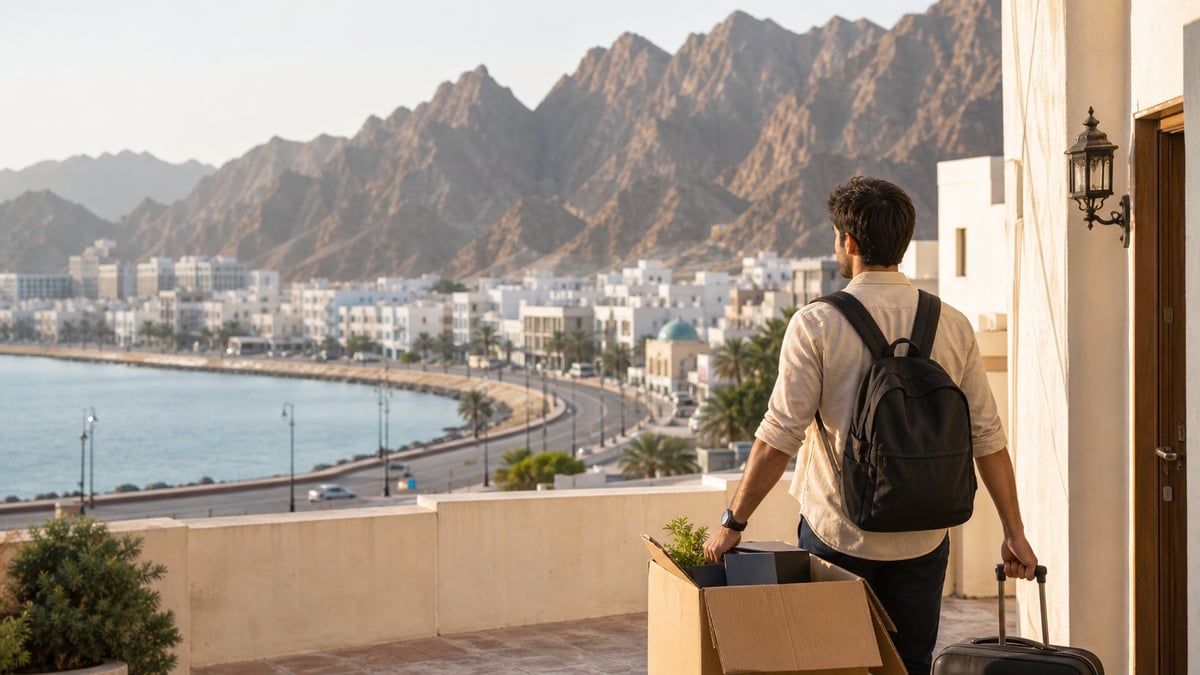
Oman is the Gulf state that decided not to build the skyline. Muscat has a building height policy that has kept it low-rise and white, the interior has genuine mountains with terraced villages and year-round wadis, the Empty Quarter is on one side and a two-thousand-kilometre coastline on the other, and the far south around Salalah catches a monsoon that turns it green while the rest of the peninsula bakes.
It also has a reputation among foreign residents for being the most personally welcoming country in the region - a consistent enough observation that it is worth mentioning as a practical feature rather than a travel-brochure line.
The trade-off is scale. The job market is narrower, the salaries are generally lower than in the UAE or Qatar, and one specific policy shapes what work is available to you at all.
Omanisation, and why it comes first
Oman runs a long-standing Omanisation policy requiring employers to meet targets for employing Omani nationals, with certain occupations and sectors restricted or closed to foreign workers entirely. The lists and quotas are revised periodically and have been tightened over time.
This is not a background detail - it is the single most important thing to check before you plan a move here, because a role that would be straightforward in Dubai may simply not be open to a foreigner in Muscat. Verify whether your occupation is affected before you invest in anything else, and be aware that an employer’s ability to sponsor you depends on their own Omanisation position.
The Oman visa section covers the current picture, and the general dynamic of employer-dependent status is in how employer visa sponsorship works.
Residence and getting set up
The mainstream route is employer-sponsored: the company obtains labour clearance and an employment visa before you travel, and arranges your resident card after arrival, following a medical examination and biometrics. Your residence is tied to that employment.
Oman also operates an investor residency programme granting longer-term residence to qualifying property buyers and investors, which does not depend on an employer and is worth investigating if you have the means, since it removes the fundamental dependency of Gulf residence.
Family sponsorship is available subject to salary and profession conditions - check them before assuming dependants can follow, per family reunification visas.
After the resident card come the bank account and the health insurance registration.
Money
There is currently no personal income tax on individual salaries, which is the regional norm, though tax policy across the Gulf has been evolving and proposals have been discussed. Take the current position from an official source rather than an older article. VAT applies to goods and services.
The standard Gulf financial discipline applies. Deal with ceasing residence properly in your home country before you go, since a tax-free salary abroad does not automatically end obligations at home - see what to sort before you leave and tax residency explained. There is no state pension accruing for you. End of service gratuity based on length of service is a genuine component of compensation.
And the region’s persistent problem with high-commission investment products sold to newly arrived expatriates applies here too - verify any adviser’s regulation independently. The general framework is managing money as an expat.
Structure is in the Oman tax section.
Healthcare
Health insurance for private sector employees is required and provided by employers under a mandatory scheme, and as everywhere in the Gulf the specifics of the plan matter far more than the fact of having one - network, limits, dependants, maternity waiting periods.
Muscat has good private hospitals and clinics. Provision outside the capital and in the interior is thinner, and for highly specialised treatment referral abroad is not unusual, which is a function of population size rather than a deficiency.
If you are drawn to living outside Muscat - and the interior and the coast are the reason many people come - factor medical access into that decision honestly. Details in the Oman healthcare section, and the general framing in health insurance for new arrivals.
Housing, cost and where to live
Rents in Muscat are moderate by Gulf standards and lower than in Dubai or Doha. Compounds and apartment buildings in areas such as Al Khuwair, Qurum, Madinat Al Sultan Qaboos and Al Mouj house much of the foreign community. Many packages include accommodation or an allowance, which is worth negotiating specifically.
International schooling is concentrated in Muscat, fees are substantial, and the choice is narrower than in the larger Gulf cities - for families this is often the binding constraint and it should be researched before accepting a role.
Imported goods are priced accordingly; fuel and cars are cheap. Overall the cost of living is more moderate than the UAE, in line with the generally lower salaries.
Muscat holds most of the employment. Salalah in the south is a genuinely different climate, catching the khareef monsoon that turns the region green from roughly June to September while the north is at its hottest - a phenomenon that draws visitors from across the Gulf. Sohar and Duqm are industrial and port centres.
Culture, climate and daily life
Oman is a conservative Muslim country and, while foreigners are treated with notable courtesy, the social norms are more traditional than in the UAE or Bahrain. Modest dress is expected, alcohol is available in licensed hotels and restaurants and to residents with a licence, and drug offences carry extremely severe penalties. Ramadan changes working hours and public norms significantly.
The summer in the north is severe from roughly May to September. Winter is the reward - genuinely pleasant, and the season when the country’s outdoors becomes the reason people stay: wadis with year-round pools, the Hajar mountains, Jebel Shams, turtle beaches at Ras al Jinz, desert camping in the Wahiba Sands, and diving along the coast. This is not a country you experience from an air-conditioned mall, which distinguishes it sharply from some neighbours.
English works throughout professional life; Arabic is appreciated and Omanis are notably patient with learners.
What catches people out
Discovering that their occupation is restricted under Omanisation after planning a move. Assuming UAE salary levels. Medical access outside Muscat. Narrow international school choice for families. And the summer heat, which is as severe as anywhere in the region.
For the regional comparison, moving to the UAE is the large, fast, high-rise neighbour, moving to Qatar is the concentrated and wealthy alternative, and moving to Bahrain is the small, socially relaxed island option.
Detail on permits, Omanisation and costs is in the Oman country guide and the cost of living section. For current experiences of employers and school places, the general forum is the place to ask.