Published by Jimmy 5 minutes read Destinations
Moving to South Korea: A First-Steps Guide for Expats
A visa system organised by lettered categories, national health insurance that newcomers must join, superb infrastructure, and a rental system built around enormous refundable deposits. Here is what living in Korea actually involves.
South Korea is a country of extremes in a way that catches people off guard. The infrastructure is exceptional - internet speeds, public transport, delivery services, digital government all operate at a level most of Europe does not approach. The food is superb. Cities are safe at any hour.
And the work culture, in traditional Korean companies, is demanding in ways that international employees frequently underestimate, the language is a substantial barrier despite an alphabet that takes an afternoon to learn, and the housing system operates on a logic unlike anywhere else.
The visa categories
Korea organises visas by lettered categories, and yours determines everything about what you may do.
E-2 is the well-known instructor visa for language teaching, requiring a degree from a qualifying country plus documentation including a criminal record check and degree verification. E-7 covers specially designated activities - the main skilled professional route, tied to a job and an employer. D-8 is investment, D-2 study, D-10 a job-seeking visa, F-2 and F-5 are longer-term residence categories, and F-6 covers spouses of Korean nationals.
Korea also runs a points-based route to longer-term residence assessing education, income, Korean language ability, age and other factors - which is worth investigating if you intend to stay, because it changes your position from employer-dependent to independent.
Your visa category strictly governs permitted activity, and working outside it is treated seriously. Changing category generally requires a new application rather than an adjustment. The South Korea visa section covers the structure, and the general architecture in visas and residence permits explained.
The ARC and getting set up
If you are staying beyond ninety days you must obtain an Alien Registration Card from immigration, within a set period after arrival. It is the key to everything: banking, phone contracts, health insurance, most services, and many websites which - genuinely - require a registration number to complete a transaction.
Book the immigration appointment early; slots in Seoul can be scarce.
Then a bank account, and a phone contract, both of which generally require the ARC. Korea’s digital services are excellent once you are inside them and quite closed until you are - the requirement for a registration number and Korean identity verification on many domestic websites is a real friction for newcomers.
Healthcare
Foreign residents staying beyond a qualifying period are generally required to enrol in National Health Insurance, either through an employer or individually, with contributions calculated on income or a standard basis.
The system is genuinely good. Coverage is broad, out-of-pocket costs are low, access is fast, and you can typically see a specialist without a referral within days. Korean healthcare has a strong international reputation and costs are a fraction of American prices.
Dental care is partly covered. Details in the South Korea healthcare section, and the general framing in public versus private healthcare.
Money and tax
Korea has a progressive income tax plus a local income tax, and residents are generally taxed on worldwide income - though there are specific provisions for foreign workers, including in some cases an election for a flat rate on employment income for a limited period, which can be advantageous for higher earners. That is exactly the sort of thing to ask a Korean accountant about rather than assume. Structure is in the South Korea tax section.
You will also be enrolled in the national pension, and there are lump-sum refund arrangements for nationals of certain countries on departure, depending on reciprocal agreements - worth checking for your nationality and recording, per moving your pension abroad.
Korean employment packages often include elements that are less common elsewhere: severance pay accruing with service, and in some contracts housing assistance or a flight allowance, which are worth understanding as part of total compensation.
Housing and the deposit system
This is the genuinely distinctive part.
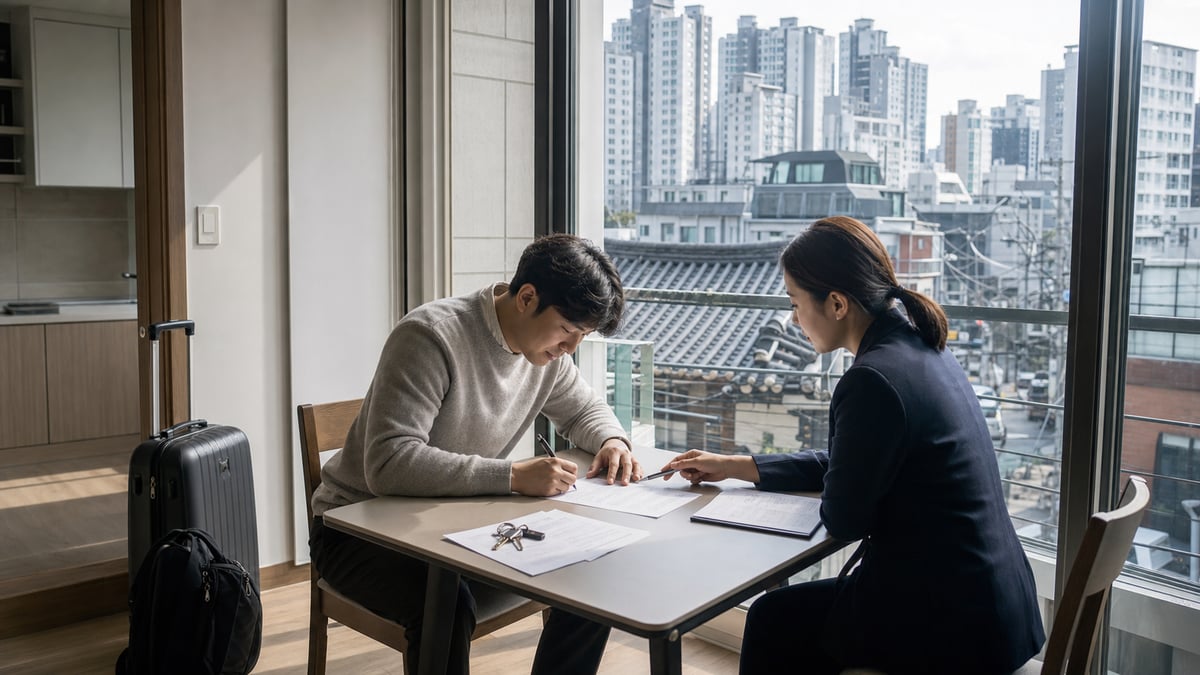
Jeonse is a system where the tenant pays a very large refundable lump sum - a substantial fraction of the property’s value - instead of monthly rent, and the landlord returns it at the end of the lease, having had use of the capital in the meantime. It requires serious capital and carries real risk: there have been well-publicised cases of deposits not being returned when landlords became insolvent. Newcomers should generally avoid it.
Wolse is monthly rent, usually with a still-substantial deposit by international standards - often many months’ worth - and lower monthly payments the larger the deposit. This is what most foreigners use.
Either way, the upfront capital requirement is much higher than in most countries, and it should be central to your financial planning before arriving. Some employers provide housing or a deposit loan, which is a very valuable benefit worth asking about.
Seoul apartments are compact and generally well equipped, with the widespread ondol underfloor heating that is one of the genuine pleasures of a Korean winter. Buildings and infrastructure are modern.
The general framing is renting your first apartment abroad, and the upfront-cost arithmetic in budgeting your first six months abroad.
Language and work culture
Hangul, the Korean alphabet, is genuinely learnable in a few hours and is one of the more elegantly designed writing systems in existence - learn it before you arrive and the country becomes navigable immediately.
The language itself is another matter: different word order, honorific levels that encode social relationships grammatically, and vocabulary with few footholds for a European speaker. English is taught widely but confidence in using it varies, and administration and most employment run in Korean.
Work culture deserves honest treatment. Traditional Korean companies have hierarchical structures, expectations around hours that exceed the statutory position, and a culture of after-work socialising - hoesik - that functions as part of professional life. Reforms have reduced the legal maximum working week and attitudes are shifting, particularly among younger workers and in international firms, but the gap between a multinational’s Seoul office and a domestic conglomerate is wide. Ask specifically.
Socially, Korea is warm and generous once you are inside a group, and group belonging matters. Age and seniority structure interactions in ways that are initially opaque and become legible with time.
Daily life
Seoul is enormous, extremely well connected and open late. Public transport is superb and cheap. Delivery culture is unmatched. Safety is excellent.
The seasons are pronounced - genuinely cold winters, hot humid summers, and spectacular spring and autumn. Air quality in spring can be poor, which is worth knowing if you have respiratory sensitivity.
Busan on the coast is the second city and has a distinctly more relaxed feel; the country outside Seoul is more traditional and much cheaper.
What catches people out
The size of the rental deposit. Website and payment systems requiring Korean identity verification. The gap between statutory working hours and actual practice in some workplaces. And underestimating the language, having learned Hangul in an afternoon and assumed the rest would follow.
For regional comparisons, moving to Japan is the closest sibling with a different housing system, and moving to Singapore is the English-language alternative in the region.
Regional detail, visa categories and cost breakdowns are in the South Korea country guide and the cost of living section. For current immigration and housing experiences, the general forum is where residents compare notes.