Published by Jimmy 5 minutes read Money & Taxes
How to Open a Bank Account Abroad (And Break the Address Deadlock)
You need an address for the account, a lease for the address and an account for the lease. That loop breaks in a predictable place. Here is the document pack banks actually want, when a digital account is enough, and when you need a real local one.
Every newcomer meets the same wall, usually in week two. The bank wants proof of address. The landlord wants a local account before they will give you a lease. The registration office wants an address before it will register you. Three doors, each locked by one of the others.
I have watched people spend a month going round that loop, and the thing that eventually breaks it is almost always the same. So let me start there, and then cover what you actually need for a proper local account once the pressure is off.
Breaking the deadlock
The weak link is the bank, and it has been for a few years now.
App-based banks across the EU, the UK and a growing list of other markets will open an account for you on the strength of a passport, a phone number and a video or selfie identity check. No local address certificate, no appointment, no branch. In many cases you have a functioning account with a local-format IBAN within a few days.
That account is usually enough to do the urgent things: receive a first salary, pay a deposit, set up direct debits, and demonstrate to a landlord that you are not entirely unbanked. It also gives you something to put on the forms that ask for bank details before you have a bank.
Two caveats worth knowing before you rely on it. First, the account’s country of issue matters in some markets - a few employers, landlords and utility companies still balk at an IBAN issued in another country, even where they are legally obliged to accept it. Second, the deposit protection and the practical recourse if something goes wrong are not always what people assume. Check both rather than assuming.
The other route, worth trying if you have any lead time, is to ask whether your existing bank has a relationship with a bank in your destination. Some large groups have newcomer arrangements that let you begin the process before you arrive. It is not common, but when it exists it removes the problem entirely.
What a traditional bank actually wants
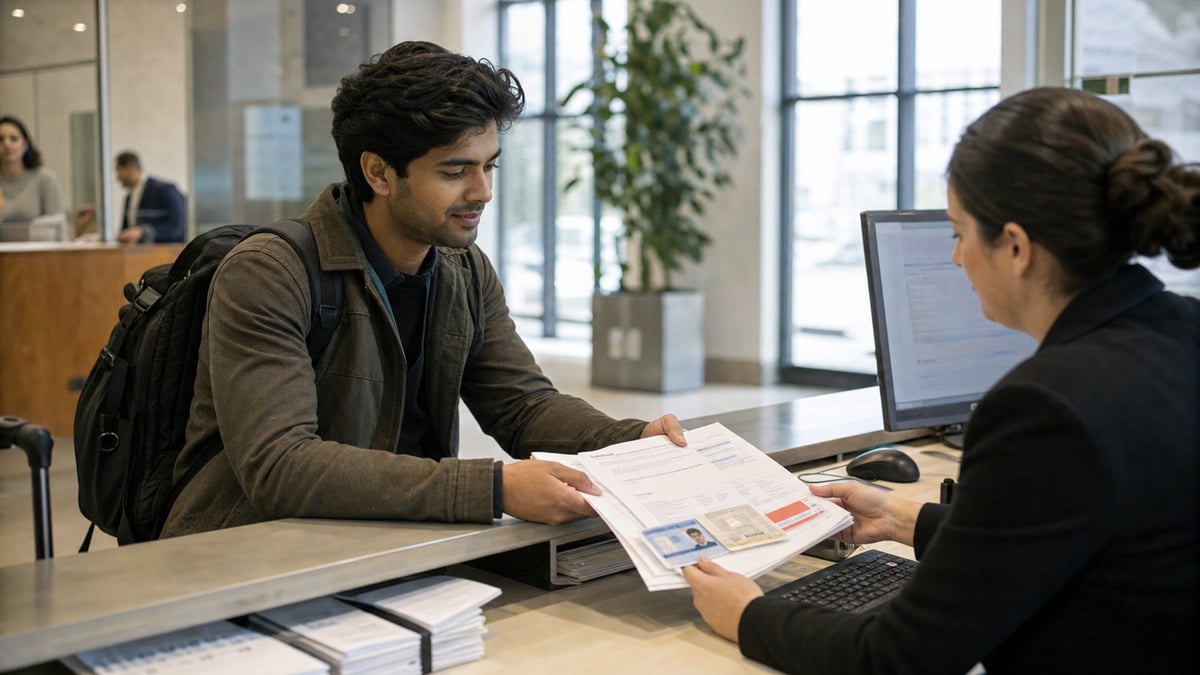
Eventually you will want a proper local account, and for that you need the document pack. It varies, but it is drawn from a fairly consistent set.
- Passport, and often a second form of identification
- Proof of a local address - usually the registration certificate from the municipality, sometimes a utility bill or a signed landlord declaration
- A local tax or identification number - the thing each country calls something different, and which frequently has to be obtained first
- Proof of status - residence permit, visa, or the confirmation that your application is pending
- Proof of income or employment - a contract or recent payslips, particularly if you want anything beyond a basic account
Bring more than the list says. Branch practice varies within the same bank, and the difference between walking out with an account and being sent away for another appointment is often one extra document you happened to have in the folder.
If you are still assembling the underlying paperwork - registration, tax number, permit - the order those things have to happen in is the whole subject of your first 90 days abroad.
The tax questions you will be asked
Every bank now asks where you are tax resident, and depending on your nationality you may be asked to self-certify under international reporting rules. American citizens in particular should expect this to be a live issue: reporting obligations mean some foreign banks simply decline US-citizen customers, which is worth knowing before you waste appointments.
Answer these questions accurately even if you are unsure of the answer - and if you are unsure, that is a sign to read tax residency explained, because it is a question you will need to answer for the tax authority sooner or later anyway.
Choosing an account rather than accepting one
Once you are past the scramble, a few things are worth comparing rather than taking whatever the first branch offers.
Monthly fees. Account maintenance charges are normal in many countries and shocking to people from markets where they are not. They are also frequently waived for salary payments above a threshold, for students, or for under-thirties - ask, because it is rarely offered.
Card type. In some countries the default card is a debit card that works differently from what you are used to, and a credit card requires a separate application and a credit history you do not yet have. Do not assume your usual card habits transfer.
International transfer costs, if you will regularly move money across borders. The account with the lowest monthly fee is often the worst at this, and the difference is larger than the fee. That trade-off is the subject of transferring money abroad without losing it to fees.
Language. Whether the app, the statements and the customer service exist in a language you can operate in under stress. This sounds trivial and is not, the first time you need to dispute a transaction.
Why you eventually want the local account
Digital accounts are excellent bridges, but there are a handful of things they do not do well.
Mortgages, in almost every market, require a local bank and usually a relationship with it. Some government payments, tax refunds and benefit systems still prefer or require a domestic account. Certain landlords and employers remain stubborn. And there is a broader point: a relationship with a local bank, with a salary landing in it month after month, is one of the few things that actually builds your standing as a resident.
That standing matters for the next problem, which is that you have no credit history in this country at all. Your account behaviour is part of what eventually fixes that, and the rest is in building credit history abroad.
Do not close everything at home
A recurring mistake. Keep a home account open at least through the transition. You will find money owed to you, subscriptions you forgot, a tax refund, proceeds from something you sold. Reopening an account from abroad, once you have no local address there, is far harder than keeping one alive.
Do update your address and residence status with them, though. Banks are required to hold accurate information, and an account whose registered address no longer matches your reality is a candidate for being frozen at the worst possible time. The wider before-you-leave list is in managing money as an expat.
A realistic timeline
Week one, open a digital account remotely or immediately on arrival, so that money can move. Weeks two and three, register your address and obtain your tax number. Week three or four, book the appointment for a traditional account and go in with the full folder. Allow another week or two for cards and credentials to arrive by post, and do not plan anything time-critical around them.
Which banks are realistic for newcomers, what each country’s tax number is called and how to get it, and the local quirks around proof of address are exactly the sort of thing covered in the banking sections of the country guides.
And if you want to know which bank actually accepted somebody in your situation last month - as opposed to which bank’s website says it might - that conversation happens in the money and banking forum. Local, current, and considerably more useful than any published list.