Published by Jimmy 7 minutes read Healthcare
Dental and Vision Care Abroad: The Bit Public Systems Usually Leave Out
Teeth and eyes are the two things most public health systems cover least, which means they are largely an out-of-pocket cost wherever you go. Here is how to find a dentist and optician as a newcomer, and whether add-on insurance is worth it.
Of all the things that surprise people about healthcare abroad, the treatment of teeth and eyes is the most consistent. You can move to a country with an excellent, generous, well-funded public health system and discover that it will set your broken leg for nothing and charge you the price of a holiday for a crown.
This is not a quirk of one country. It is close to a universal pattern: dental and optical care sit outside or at the edge of most public systems, and are largely paid for privately by everyone, locals included.
Which means these are costs to plan for rather than assume away, and they are worth handling early - partly because dental problems do not improve with waiting, and partly because the sensible time to buy insurance for them is before you need it.
Why they are excluded
There is a historical logic to it. Most public systems were built around treating illness and injury rather than maintaining teeth and vision, and dentistry in particular has stayed largely private in the majority of countries, with public involvement limited to children, emergencies, and low-income groups.
The result is a fairly consistent pattern:
- Children are frequently well covered for dental care, sometimes entirely free until a certain age
- Adults get much less - commonly emergency treatment, extractions and sometimes a subsidised annual check-up
- Restorative work - fillings, crowns, root canals, bridges, implants - is usually private, or reimbursed at a low percentage
- Orthodontics is often covered for children on medical grounds and almost never for adults
- Eye tests for adults are usually paid, and glasses and contact lenses almost always are
Some countries reimburse a set percentage of a set fee, which sounds generous until you learn that the set fee bears little relation to what dentists actually charge and the gap is yours. This is exactly the pattern I describe in public versus private healthcare: being covered and paying nothing are different things.
Do the work before you leave
The most useful advice in this post is not about the new country at all.
While you are still in a system you are entitled to and understand, use it. Get the check-up, get the outstanding work done, get the eye test, get a spare pair of glasses or a supply of lenses, and get your prescriptions - both optical and medical - written down.
Two reasons. The obvious one is cost and familiarity. The less obvious one is that there is always a gap between arriving and being able to see anyone, and dental problems have a habit of surfacing precisely during it. Turning up to an unfamiliar system in pain, in a language you are still learning, without a dentist, is a bad afternoon.
This belongs alongside the other pre-departure health errands in what to sort before you leave, and it pairs with bringing a written medical summary.
Ask your dentist for your records too, including recent x-rays. A new dentist starting from nothing will usually want to take their own, and having the history avoids both the cost and the radiation.
Finding a dentist as a newcomer
The important structural point: dental registration is almost always separate from medical registration. Getting a family doctor, as described in registering with a doctor, does not get you a dentist. You have to do it yourself, and most people do not realise until they need one.
How to go about it:
Ask people. Colleagues, neighbours, other parents. Personal recommendation is far more useful here than reviews, and people are happy to be asked.
Establish the payment model before booking. In countries with a mixed system, some practices treat under the public scheme and some are wholly private, and the difference in price is large. Ask directly.
Ask the price of a check-up when you call. A practice that will not quote for a routine examination is telling you something.
Consider language. Dental appointments involve consent to procedures and discussion of options, and doing that at the edge of your language ability is unwise. A practitioner who shares a language with you is worth some inconvenience, and in most cities they exist.
Go before something hurts. A first appointment as a routine check establishes you as a patient, which matters when you later need an emergency slot. Practices prioritise their own patients.
Also find out how out-of-hours dental emergencies work locally, because it is often a completely separate arrangement from general medical emergency care - a rota, a dedicated clinic, a specific number. Worth knowing on a calm Tuesday rather than at midnight.
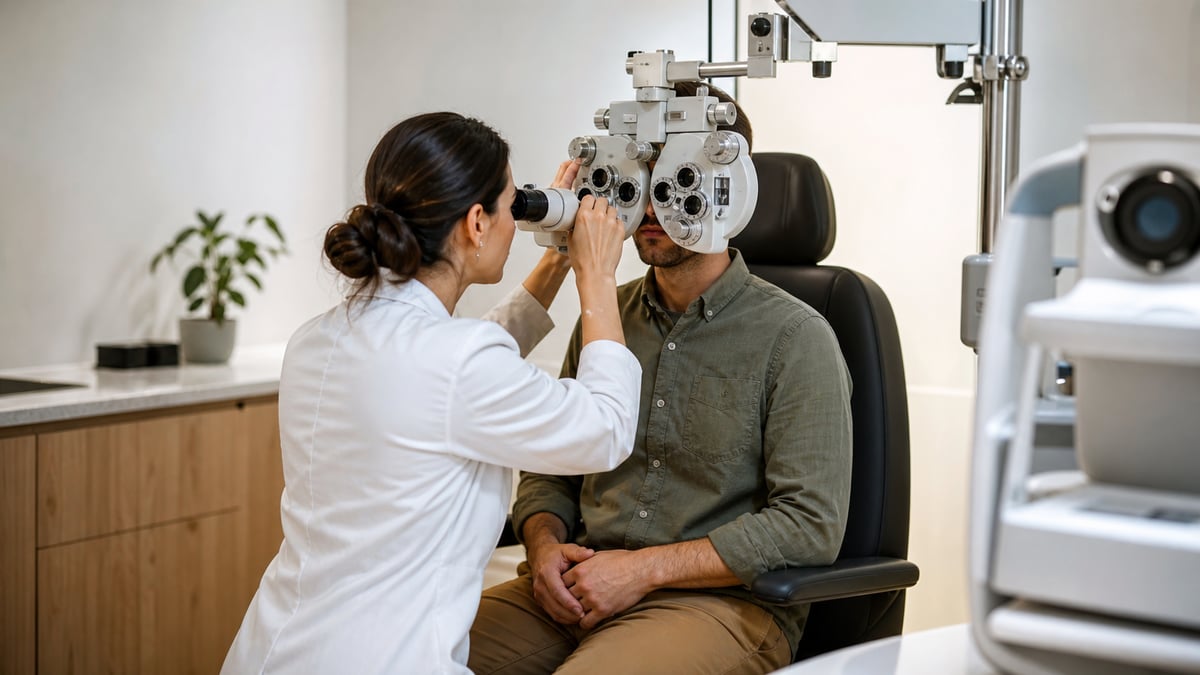
Opticians and eye care
Broadly similar, with one distinction worth understanding: many countries separate the optician who tests sight and sells glasses from the ophthalmologist who is a medical doctor treating eye disease.
Routine sight testing and eyewear is usually a private, paid service. Medical eye problems - infections, injuries, disease, and monitoring conditions like glaucoma or diabetic eye disease - are far more likely to be covered by the public system, sometimes requiring a referral from your family doctor.
So if you have an ongoing eye condition, that is a medical matter and should be raised with your family doctor early, with your records to hand. If you simply need glasses, that is shopping.
A few practical notes. Prescriptions are written in a standard notation that transfers between countries, so bring yours. Some countries will not dispense glasses on a foreign prescription beyond a certain age of the test, so expect to be retested. Contact lens supply is sometimes restricted to a prescription and sometimes freely available. And prices for the same lens type vary enormously between chains and independents in a way that has little to do with quality - it is worth getting two quotes.
Is the add-on insurance worth it?
This is the question I get asked most on this topic, and the honest answer is: sometimes, and less often than the marketing suggests.
Dental and optical are frequently sold as supplementary cover, either standalone or bolted onto a health policy. Before buying, read for four things.
Waiting periods. Almost universal on dental policies, commonly six to twelve months for anything beyond a check-up, and longer for major work. A policy bought because you need a crown will not pay for that crown.
Pre-existing exclusions. Existing problems are typically excluded outright. Insurers frequently require a recent dental examination before cover begins, precisely to establish what is already wrong.
Annual caps. Dental policies usually cap the total they will pay in a year, sometimes at a level below the cost of a single significant treatment. A cap set below the price of one crown is not really insurance.
Co-insurance. Many policies pay a percentage rather than the full cost, and the percentage often steps down for more expensive categories of work.
Run the arithmetic: annual premium against realistic annual cost. For someone with healthy teeth needing two check-ups and a clean, insurance usually loses. For someone with a history of problems, or a family with children needing orthodontics, it can win comfortably - but check whether orthodontics is covered at all, since it is often excluded or heavily capped.
The alternative, and it is a perfectly respectable one, is to self-insure: set aside what the premium would have cost and pay for treatment directly.
If you do buy, buy it early rather than reactively, precisely because of the waiting periods - which is the same logic that applies to the bridging cover in health insurance for new arrivals.
Employer cover and the children exception
If your employer provides health insurance, check whether dental and optical are included - they often are, at least partially, and it is one of the more valuable elements of a package. Check whether family members are covered, and what happens if the job ends.
And do check the position for children specifically. In a great many countries children’s dental care is covered far better than adults’, sometimes entirely, and orthodontic treatment may be covered where there is a clinical need. Registering children with a dentist early is part of the wider set of things to sort in moving abroad with kids.
A word on dental tourism
You will encounter this. In a number of countries dental work costs a fraction of what it does elsewhere, and people genuinely travel for it.
It can be entirely legitimate and it can go wrong. The considerations: what happens if something needs correcting after you have flown home, whether the practitioner is registered and insured, whether the materials and standards meet what you expect, and whether follow-up is included. Complex work requiring multiple visits is more suited to it than one-off emergency treatment.
If you go this route, treat it like any other significant purchase: verify the registration yourself, get the treatment plan and the price in writing before travelling, and be sceptical of quotes that are dramatically below even the local norm.
Which treatments are covered where, at what reimbursement rate, and what a check-up typically costs are in the healthcare and insurance sections of the country guides - and for the specific question of which dentist in your city is good and speaks your language, the health and insurance forum is where people pass on names.