Published by Jimmy 6 minutes read Family & Education
Raising Bilingual Kids Abroad: What Actually Works, and the Myths
Children abroad pick up the local language faster than you will. Keeping the home language is the harder half, and it slips quietly. Here are the approaches that work, the worries you can safely drop, and the point at which to get advice.
Within a few months of moving, your child will be correcting your pronunciation. This is delightful and mildly humiliating, and it is also the point at which a different problem starts, quietly, in the background: the home language beginning to slip.
Nobody notices it happening. It shows up as your child answering in the local language when you speak to them in yours, then as a shrinking vocabulary, then - a couple of years later - as a child who understands you perfectly and cannot really speak your language at all.
That outcome is common and it is avoidable. It just requires some deliberate effort during a period when you have very little spare capacity.
The myths you can drop
Let me clear these first, because they cause a lot of unnecessary worry.
Bilingualism does not cause speech delay. This is the persistent one, and it is not supported by the evidence. Bilingual children hit language milestones within the normal range when you count vocabulary across both languages together, which is the correct way to count. If a child is genuinely delayed, bilingualism is not the cause and reducing to one language is not the treatment - get a proper assessment instead.
Mixing languages is not confusion. Children who slot a word from one language into a sentence in another are doing something sophisticated: filling a gap with the word they have. Adult bilinguals do it constantly. It sorts itself out.
You do not have to be perfectly consistent. Some approaches recommend rigid separation, and rigidity is not what makes it work. Regular, meaningful exposure is.
It is not too late. Children add languages efficiently well into their teens. Later is harder, and later is not impossible.
Your accent does not matter. Nor does your slightly outdated slang. Your child gets the local language, at native level, from school and everyone around them. What only you can give them is your language.
The asymmetry that defines the whole thing
Here is the structural point that shapes every decision.
The local language will take care of itself. School, nursery, friends, television, shops, the street. It arrives with overwhelming force and your child will end up more fluent in it than you.
The home language will not. It has one or two speakers, in one building, for a couple of hours a day, competing against everything else. It is the underdog by an enormous margin, and if you do not actively support it, it loses.
So almost all of your effort should go into the language that has the weaker position. Parents sometimes do the opposite - speaking the local language at home to “help” - and it is the single most common way the home language is lost. School does that job better than you can.
Approaches that work
There are named methods, and the useful thing to know is that the method matters less than the exposure.
One parent, one language. Each parent consistently uses their own language with the child. Clear, easy to explain to others, and effective. It gives each language a person attached to it, which children find intuitive.
Minority language at home. Everyone speaks the home language inside the house; the local language lives outside. Particularly strong when both parents share the home language, because it creates a genuine domain rather than a habit.
Time or place based. Certain days, or certain activities, in one language. More flexible, requires more discipline to sustain.
Pick whichever fits your family and can survive a hard week. A method you abandon in month three is worth less than a looser one you keep for ten years.
What actually keeps a language alive
The methods are scaffolding. These are the things that do the real work.
People who only speak it. This is by far the most powerful factor. Grandparents, cousins, family friends - anyone the child cannot communicate with any other way. A child who wants to talk to their grandmother will learn to talk to their grandmother. Regular video calls, and visits where they are immersed for a few weeks, do more than any amount of home practice. If those relationships exist, protect the time for them.
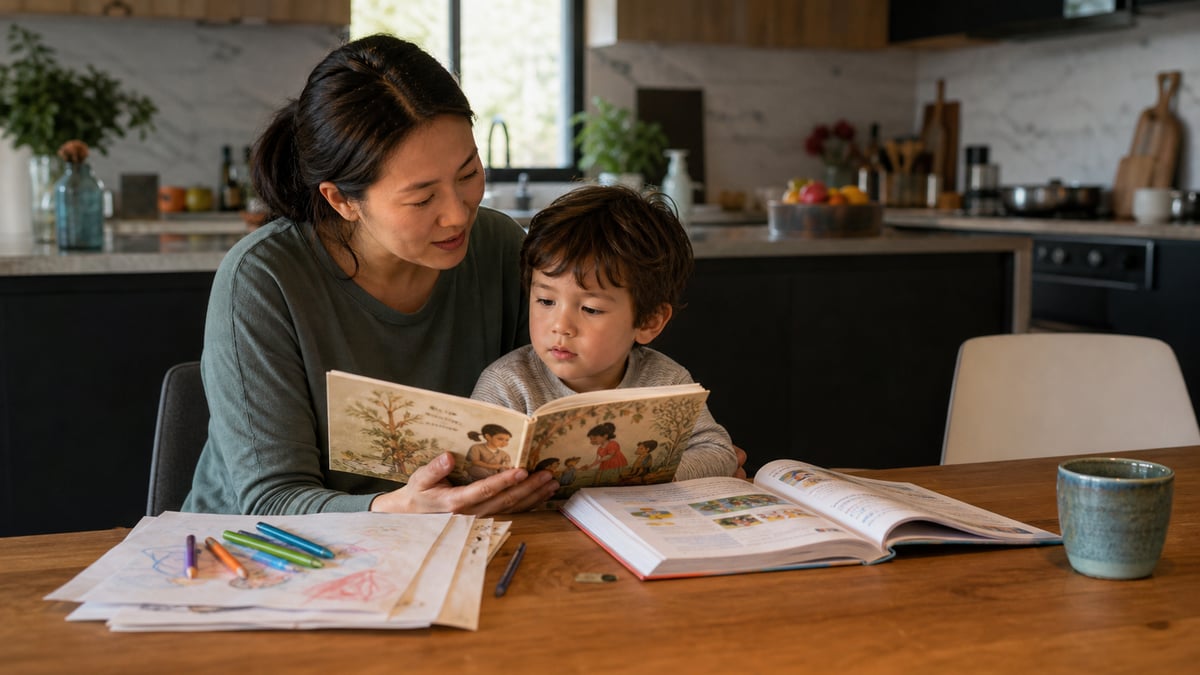
Reading. Books in the home language, from the start and continuing well past the age when children read to themselves. This is what builds vocabulary beyond the domestic and the everyday - the difference between a child who can discuss dinner and one who can discuss ideas.
Media they actually want. Films, series, games, music, audiobooks in the home language. Not educational content unless they like it; the point is that the language carries things they enjoy.
A domain that is genuinely theirs. A sport, a weekend school, a community group, a summer camp, cousins. Anything where the language is the medium of something fun rather than an obligation.
Answering in the language. The most common tipping point is when a child starts replying in the local language while you continue in yours. Handled gently - repeating back in your language, asking them to say it again, playing dumb occasionally - it is recoverable. Left alone, it becomes the settled pattern within a year.
The stages to expect
Toddler to preschool. Both languages develop together, mixing is normal, and progress feels effortless.
Starting school. The local language accelerates dramatically and often becomes dominant within months. This is when home language attrition typically starts, and when your deliberate effort matters most.
Primary years. Usually stable if you have kept the input up. This is the window to build literacy in the home language, because reading and writing do not come automatically the way speech does, and without them the language stays at a childhood ceiling.
Adolescence. Peer language dominates and children may actively resist the home language, sometimes as part of not wanting to be different. Pushing hard here often backfires. Keeping the language attached to things they value - family, music, travel, an identity they are proud of - works better than insistence.
Worth knowing: many children who resist in their teens come back to it in their twenties, and often express regret that they let it slide. Keeping a foundation in place is worth it even through a resistant phase.
Two things that are genuinely different from monolingual parenting
Academic language is not conversational language. A child who chats happily in the local language may still be well behind in written work, because the vocabulary of instruction takes years longer to acquire. Do not read early playground fluency as evidence that no support is needed at school - ask specifically what language support the school provides, as covered in international versus local schools.
Do not use your child as an interpreter. It is tempting when they are fluent and you are not, and it is well documented as a burden - putting children into adult situations, medical conversations and conflicts they should not be in, and inverting the family relationship. Use professional interpreters where they exist, and treat it as one more reason to do your own language work, which is the argument in learning the local language fast.
When to actually seek advice
Bilingualism is not a reason to worry, but children can have language difficulties like anyone else. Get an assessment if a child is significantly behind milestones in both languages combined, if they lose language they previously had, if there are comprehension difficulties in the stronger language, or if there are wider communication concerns.
Ask specifically for someone experienced with bilingual children, because assessment in only one language of a bilingual child can badly misrepresent their ability. Where that expertise exists locally, your family doctor or the school is the route to it - see registering with a doctor.
And the long view
The effort is real, particularly in the years when you are also dealing with everything else in moving abroad with kids and the nursery logistics in childcare and daycare abroad.
What you get for it: a child who can talk to their whole family, who has a second culture available to them rather than described to them, and who has an asset that is very hard to acquire later. And if you ever move again - back home or onwards - a maintained home language is what makes that possible without it being a rupture.
That is the quiet argument for keeping it up even when it feels like extra work in an already full year. Languages are much easier to keep than to rebuild.
Which languages a country actually uses, what school language support exists and whether community language schools operate locally are in the education and language sections of the country guides - and for finding other families keeping the same language alive in your city, the language learning forum is a good place to start looking.