Published by Jimmy 5 minutes read Destinations
Moving to Finland: A First-Steps Guide for Expats
Finland pairs a famously functional society with a famously difficult language and a genuinely dark winter. For families and for people in technology it can be superb - here is the residence permit, the henkilötunnus and the honest seasonal warning.
Finland tends to arrive in people’s shortlists via a statistic - the happiness rankings, the education system, the low corruption, the functioning public services. All of that is real, and none of it quite prepares you for the two things that actually shape a Finnish year: the language, and the light.
Neither is a reason not to go. Both are reasons to go with your eyes open.
The right to stay
EU citizens register their right of residence with the authorities after arriving, rather than applying for a permit, and may live and work freely. Nordic citizens have an even simpler arrangement between the Nordic countries.
Non-EU nationals apply to the Finnish Immigration Service, usually before travelling, and complete an identification step at a Finnish mission or service point. The main categories are the specialist permit for expert roles, permits for employed persons - some of which involve a labour market consideration - permits for students, family ties, and start-up entrepreneurs. Finland has been actively trying to attract skilled workers and has streamlined some routes, so check the current position rather than an older description. The Finland visa section covers the structure.
Finland’s technology and gaming sectors in particular recruit internationally as a matter of course, which makes the process routine for many employers.
The identity code and the first steps
The henkilötunnus - the personal identity code - is Finland’s identifier and is needed for banking, healthcare, employment and public services. You obtain it when your details are registered, and you separately register your municipality of residence, which is what gives you access to local services including healthcare.
Both matter, and people sometimes get the identity code without completing the municipal registration and then wonder why the health centre cannot help them. Do both.
Then a bank account, which in Finland also gives you access to online banking credentials used as a digital identity for government and commercial services - the Finnish equivalent of the Nordic digital ID pattern, and equally central to daily life.
The general dependency chain is your first 90 days abroad; Finland’s version is comparatively efficient once you are in the system.
Healthcare
Public healthcare is provided through the regional wellbeing services and is available to residents registered in a municipality, with modest fees for many services. Care standards are good; waiting times for non-urgent treatment are the standard domestic complaint.
Two Finnish specifics. Occupational healthcare is a significant part of the system - employers are required to provide it, and in practice many employees receive a substantial share of their primary care through it, often faster than through the public health centre. It is a real benefit worth asking about in a job offer.
And student healthcare is organised separately for higher education students.
Details in the Finland healthcare section, and the general model question in public versus private healthcare.
Money and tax
High taxation, high services, in the Nordic pattern. Income tax combines state and municipal elements, and you obtain a tax card which your employer uses; without it, withholding defaults to a high rate.
Finland has a scheme offering a flat tax rate for certain foreign key employees for a limited period, subject to conditions including a salary threshold and the nature of the role. Worth asking about if you are arriving in a specialist position.
The services that the taxes buy are the argument, and for families they are substantial: free education including university tuition for EU citizens and for many others, subsidised childcare with income-related fees, and generous family leave. The Finnish school system’s reputation is largely deserved and it is a genuine draw for families - the general choice framework is international versus local schools, though in Finland the local system is usually the answer.
Structure is in the Finland tax section.
Housing and cost
Helsinki is the expensive part and it is not extreme by Nordic standards; Tampere, Turku, Oulu and Jyväskylä are considerably cheaper and are genuine cities with real employment, particularly in technology and engineering.
Rental practice is straightforward, with deposits typically one to three months. Housing stock is generally well insulated and heated to a standard that makes the winter a non-issue indoors - a pleasant contrast with southern Europe, where the buildings are the problem rather than the weather.
Many Finns own or have access to a mökki, a summer cottage, which is central to how the year is structured. Summers are short, intense and spent outdoors, and the country empties into the lakes in July.
The language
Finnish is not related to the Germanic or Romance languages and it is genuinely hard for most learners - extensive case system, unfamiliar vocabulary, and a substantial gap between the written standard and colloquial speech. Swedish is the other official language, spoken by a minority and dominant in some coastal areas.
The compensation is that English proficiency is very high, and technology, research, gaming and international business run in English without difficulty.
The honest trade-off: you can live and work here for years in English, and you will remain somewhat outside. Free or subsidised Finnish courses are available to residents and are worth taking, slowly, without expecting fast progress. See learning the local language fast.
The light, and the social question
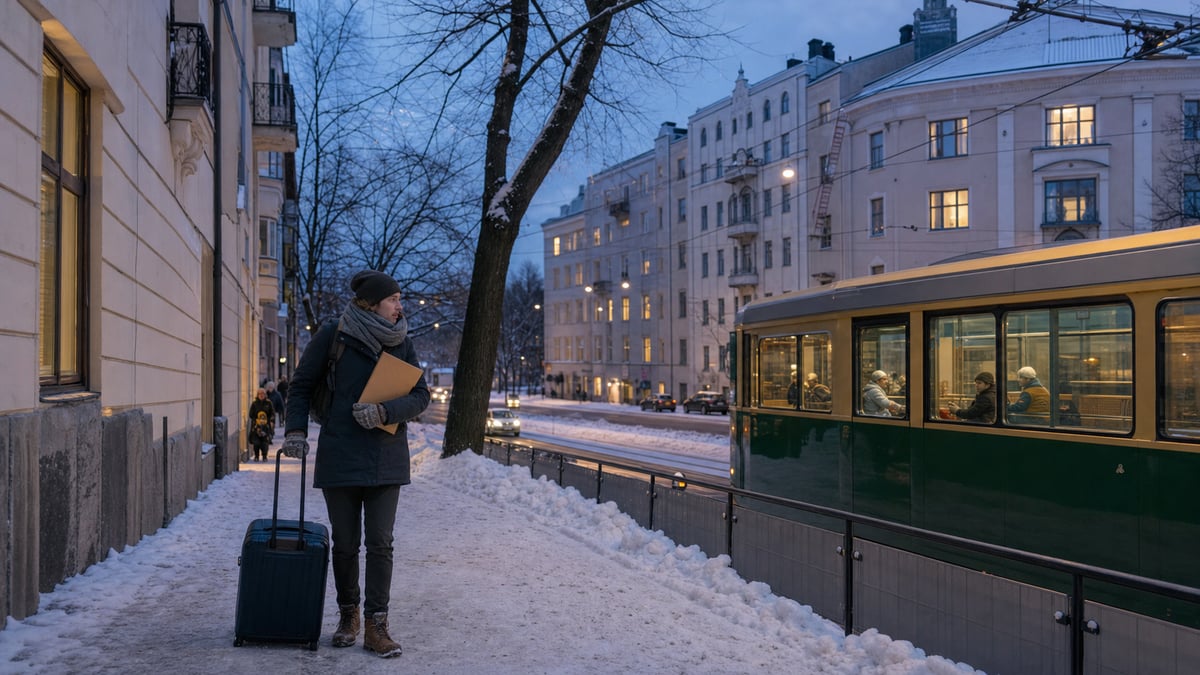
The winter darkness is the adjustment nobody fully anticipates. In Helsinki, midwinter days are very short; in Lapland the sun does not rise for a period. It affects sleep, mood and energy, and it is worth taking seriously - light therapy, vitamin D, exercise and a deliberate social calendar are what Finns themselves use.
Then in June the reverse happens, and the endless light is genuinely extraordinary.
Socially, Finland is the most reserved of the Nordics and takes the longest to open. Finnish friendliness is quiet and completely sincere once established. The sauna is a real social institution and one of the more effective ways to be included. Otherwise the usual applies: clubs, courses, sports, repetition - beating culture shock and building a social life.
What catches people out
The first winter, particularly for people arriving in autumn who have never experienced it. Underestimating how hard the language is and giving up rather than pacing it. And missing the municipal registration step and therefore healthcare access.
For the regional picture, moving to Sweden is the closest comparison with an easier language, moving to Estonia is an hour away by ferry with a very different cost base, and moving to Norway offers higher pay and higher prices.
Regional detail, permit routes and cost breakdowns are in the Finland country guide and the cost of living section. For current permit processing experiences, the general forum is where people report back.